
Boxing Decision Simulator
Three judges have scored a close fight. Select which fighter each judge thinks won to see the official result.
Judge 1
Judge 2
Judge 3
Official Result:
You watch the final bell ring. One fighter stands tall, the other is on the canvas. The referee waves his arms, the crowd erupts, and the announcer screams a result that feels like poetry but sounds like legal jargon. You hear "Unanimous Decision," "Technical Knockout," or maybe just "Knockout." But what do these terms actually mean? More importantly, why does it matter how a boxer wins?
In boxing, not all victories are created equal. A win by knockout carries more prestige than a split decision, and understanding the difference changes how you watch the sport. It’s not just about who raises their hand; it’s about how they got there. Let’s break down the specific names for every type of boxing victory, from the cleanest knockouts to the most controversial judge’s scores.
The Knockout (KO): The Clean Sweep
The gold standard in boxing is the Knockout, often abbreviated as KO. This is the moment everyone waits for. A fighter lands a punch that sends their opponent crashing to the floor, unable to beat the ten-count administered by the referee.
For a result to be officially recorded as a KO, the fighter must be knocked down and fail to stand up before the referee counts to ten. If they get up at count nine, it’s not a KO-it’s a different story entirely. The KO is the only way to win where the fight ends immediately due to the physical inability to continue, without any medical intervention or corner involvement.
Historically, KOs define legends. Muhammad Ali’s "Rumble in the Jungle" against George Foreman was a KO in the eighth round. It wasn’t just a win; it was a statement. In modern boxing, a KO often boosts a fighter’s marketability significantly more than a decision win because it demonstrates dominant power and finishing ability.
- Definition: Opponent knocked down and fails to rise before count of 10.
- Record: Listed as "W-KO" in the fighter’s professional record.
- Prestige: Highest level of dominance.
The Technical Knockout (TKO): When It’s Over Before the Count
If a KO is a clean sweep, a Technical Knockout, or TKO, is a safety stop. This happens when a fighter is still standing but is clearly unable to defend themselves intelligently. The referee steps in to protect them from further damage.
A TKO can also occur if a fighter’s corner throws in the towel, signaling surrender to save their client from unnecessary punishment. Additionally, if a fighter suffers an accidental head clash that causes a cut too severe to continue, or if they cannot pass a medical examination between rounds, the result is often ruled a TKO.
Here is the key distinction: In a KO, the fighter is down and stays down. In a TKO, the fighter might be down, but the referee stops the fight before the count reaches ten because they see the fighter isn’t moving properly or is taking unanswered shots. Sometimes, a TKO is awarded even if no one has been knocked down, simply because one fighter is getting hammered with no response.
| Feature | Knockout (KO) | Technical Knockout (TKO) |
|---|---|---|
| Referee Action | Counts to 10 | Stops fight early |
| Fighter Status | Down and out | Standing or down, but defenseless |
| Common Cause | One powerful punch | Cumulative damage or injury |

Decisions: The Judges’ Verdict
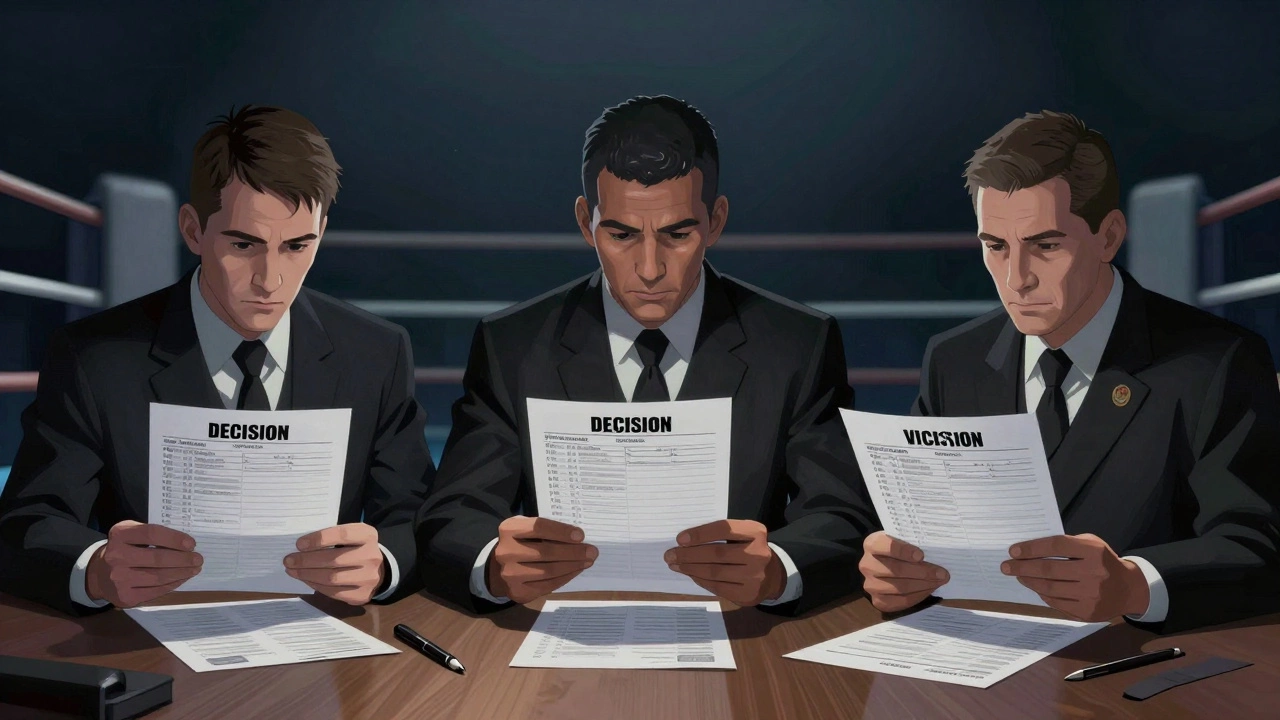
Not every fight ends with a body on the floor. Many bouts go the distance-meaning all scheduled rounds are completed-and the winner is determined by the judges’ scorecards. These are called Decisions. There are three main types, and the difference between them comes down to how closely the judges agreed.
Unanimous Decision (UD): All three judges scored the fight for the same winner. This is the clearest form of decision victory. It suggests that the winning fighter dominated enough that there was little room for argument. For example, if Canelo Alvarez wins by UD, it means all three officials saw him controlling the pace and landing more significant punches.
Split Decision (SD): Two judges score for one fighter, and one judge scores for the other. This indicates a very close fight where opinions differed. Split decisions are often controversial because they highlight subjectivity in scoring. Fans of the loser usually feel robbed, while fans of the winner celebrate a hard-fought grind.
Majority Decision (MD): Two judges score for one fighter, and the third judge scores the fight a draw. This is rare. It happens when two judges see a clear winner, but the third sees both fighters performing equally well. It’s a messy result that often leaves everyone confused.
The Draw: No Clear Winner
Sometimes, the judges cannot agree on a winner, or they believe both fighters performed equally. This results in a Draw. While not a victory, it’s a critical outcome in boxing records. Draws are categorized similarly to decisions:
- Unanimous Draw: All three judges score it a draw.
- Split Draw: One judge scores for Fighter A, one for Fighter B, and one scores a draw.
- Majority Draw: Two judges score a draw, one scores for a fighter.
Draws are frustrating for promoters and fans alike. They don’t advance the narrative of a rivalry, and neither fighter gets the satisfaction of a win. However, in high-stakes title fights, a draw often leads to a rematch clause being triggered.
Disqualifications (DQ) and No Contests (NC)
Boxing is a regulated sport, and breaking the rules has consequences. If a fighter commits a serious foul-like hitting below the belt repeatedly, using the head as a weapon, or holding and hitting-they can be Disqualified. The opponent is awarded the victory by DQ. This is a win, but it’s often viewed as hollow because it wasn’t earned through skill alone, but through the opponent’s misconduct.
Then there is the No Contest, or NC. This occurs when the fight cannot be completed due to reasons outside the fighters' control, such as an accidental eye poke that blinds a fighter before four rounds have passed, or a force majeure event like a power outage in the arena. In a No Contest, neither fighter wins or loses; the result is erased from their records as if the fight never happened.
Why the Type of Victory Matters
You might wonder why we need so many labels. Isn’t a win a win? In boxing, the method of victory dictates future opportunities. Promoters love KOs and TKOs because they sell tickets. A fighter known for stopping opponents is seen as a closer, someone who can finish business. This makes them more attractive for main events and pay-per-view bouts.
Decision winners, especially those who win by unanimous verdicts, are respected for their stamina and ring generalship. They are often seen as technicians who can outbox opponents over twelve grueling rounds. However, relying solely on decisions can make a fighter look soft to casual fans.
Understanding these terms helps you appreciate the nuance of the sport. When you hear a fighter won by TKO in the seventh round, you know they were battered but survived. When you hear a Unanimous Decision, you know it was a chess match. Each label tells a different story about the night’s drama.
What is the difference between a KO and a TKO?
A Knockout (KO) happens when a fighter is knocked down and cannot beat the referee's ten-count. A Technical Knockout (TKO) occurs when the referee, doctor, or corner stops the fight because a fighter is unable to continue safely, even if they haven't been counted out.
What does a Split Decision mean in boxing?
A Split Decision means that two of the three judges scored the fight for one winner, while the third judge scored it for the other fighter. It indicates a very close contest with differing opinions among the officials.
Can a boxing match end in a draw?
Yes, a boxing match can end in a draw if the judges cannot agree on a winner or believe both fighters performed equally. Draws can be unanimous, split, or majority, depending on how the individual scorecards are tallied.
What is a Disqualification (DQ) in boxing?
A Disqualification occurs when a fighter violates the rules so severely that the referee removes them from the bout. The opponent is declared the winner by DQ. Common causes include repeated fouls, low blows, or headbutting.
What is a No Contest (NC)?
A No Contest is declared when a fight cannot be completed due to unforeseen circumstances, such as an accidental injury before four rounds have passed. Neither fighter wins or loses, and the result is typically removed from their professional records.