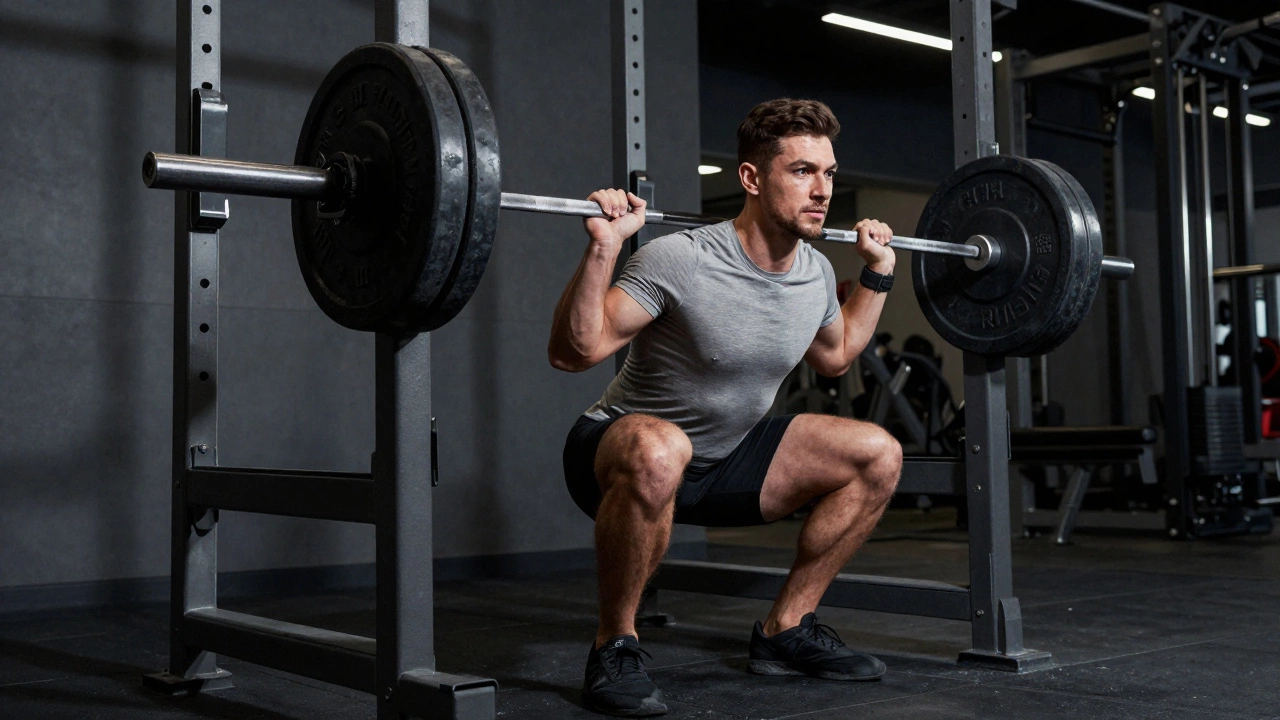
Squat Variation Muscle Engagement Tool
Select a squat variation to see how it impacts your body's muscle groups and total body engagement.
Back Squat
Maximum load capacity
Goblet Squat
Great for form & core
Pistol Squat
Elite balance & strength
Variation Analysis
Muscle Engagement Levels
Most people think of squats as just a "leg day" staple. You picture someone in a gym, struggling under a barbell, focusing entirely on their thighs. But here is the thing: if you only feel squats in your quads, you are probably doing them wrong. The truth is that a proper squat is one of the most demanding movements you can do because it forces almost every major muscle group to work in harmony to keep you from collapsing under the weight.
Key Takeaways
- Squats are compound movements that hit the lower body and core simultaneously.
- They trigger a systemic hormonal response that aids overall muscle growth.
- Upper body engagement happens through stabilization and bracing.
- Form is the difference between a full-body workout and a knee injury.
Breaking Down the Muscle Map
To understand why full body squats are so effective, we need to look at what is actually happening under the skin. A squat isn't just one movement; it is a chain reaction of muscle contractions.
The primary drivers are your Quadriceps, those four large muscles on the front of your thigh. They handle the bulk of the extension as you push back up. But they don't work alone. Your Gluteus Maximus-the strongest muscle in the human body-is responsible for driving the hips forward and stabilizing the pelvis. If you've ever felt a "burn" in your glutes after a heavy set, that's the power plant of the squat kicking in.
Then you have the posterior chain. The Hamstrings act as stabilizers, preventing your knee joint from shearing, while the calves provide the final push-off from the floor. But where does the "full body" part come in? Look at your torso. To keep a barbell from folding you like a piece of paper, your Core (including the transverse abdominis and obliques) has to create massive internal pressure. This is essentially a weighted plank performed while moving.
The Upper Body Connection
You might wonder why we call it a full-body exercise when you aren't doing a bench press or a pull-up. The secret lies in stabilization. When you hold a heavy weight on your shoulders, your Erector Spinae-the muscles running up your spine-work overtime to keep your back flat. If these muscles fail, your chest drops, and the lift ends.
Your upper back and shoulders also play a role. In a back squat, the Trapezius and posterior deltoids create a "shelf" for the bar to sit on. If you've ever noticed that your shoulders feel tired after a leg session, it's because they've been fighting to hold that load in place for ten reps. Even your grip and forearms are engaged if you're doing goblet squats or holding dumbbells.
| Muscle Group | Back Squat | Goblet Squat | Pistol Squat |
|---|---|---|---|
| Quadriceps | High | High | Extreme |
| Glutes | High | Medium | High |
| Core/Abs | Medium | High | Extreme |
| Upper Back | High | Medium | Low |
The Hormonal Ripple Effect
Beyond the physical tension, squats do something that bicep curls simply cannot: they trigger a systemic response. Because Compound Exercises recruit so many muscle fibers at once, the body reacts by releasing a surge of growth-promoting hormones.
When you challenge a large percentage of your muscle mass, your endocrine system pumps out more Growth Hormone and testosterone. This isn't just about your legs getting bigger. These hormones circulate throughout your entire bloodstream. This means the heavy squatting you do on Monday can actually help your chest and arms grow on Wednesday. It is a biological "multiplier" effect that makes full-body training more efficient than isolating every single muscle with a different machine.
Common Pitfalls That Kill the Full-Body Benefit
A lot of people cheat their way through squats, and in doing so, they turn a full-body powerhouse into a simple knee-extension exercise. The most common mistake is the "half-squat." If you only go down a few inches, you completely bypass the glutes and the deep core engagement. You're essentially just doing a leg press without the machine.
Another issue is the "butt wink," where the lower back rounds at the bottom of the movement. When this happens, the load shifts from your muscles to your spinal discs. Instead of your core working to stabilize the weight, your ligaments are taking the hit. To fix this, focus on keeping your chest up and pushing your knees outward. If you can't hit depth without rounding your back, stop and work on your ankle mobility first.
How to Maximize Total Body Engagement
If you want to make sure you're hitting every inch of your body, try these specific tweaks to your routine:
- The Bracing Technique: Before you descend, imagine someone is about to punch you in the stomach. Take a deep breath into your belly (not your chest) and tighten everything. This turns your torso into a rigid cylinder, maximizing core recruitment.
- Slow Down the Eccentric: Don't just drop. Take three seconds to lower yourself. This increases the "time under tension" for your stabilizing muscles and forces your nervous system to work harder to maintain balance.
- Switch Your Grip: If you're doing goblet squats, hold the weight tightly. The isometric contraction in your arms and chest adds an extra layer of upper-body work.
- Pause at the Bottom: Spend one second in the hole. This kills the momentum and forces your glutes and core to ignite from a dead stop to get you back up.
Integrating Squats into a Balanced Routine
While squats are incredible, they aren't the only tool in the shed. To get a truly complete physique, you need to pair them with "pulling" movements. Since squats are primarily a "push" movement (pushing the floor away), you should balance them with something like deadlifts or weighted rows. This ensures that while your quads and core are getting hammered, your upper back and hamstrings get an equal amount of attention.
For a beginner, starting with bodyweight squats is the way to go. Once you can do 20 perfect reps with a flat back and full depth, move to goblet squats. Only once you have mastered the stability and the "brace" should you move to the barbell. Jumping straight to the rack without the foundational movement pattern is a recipe for a lower back injury.
Do squats burn more calories than other exercises?
Yes, generally. Because squats engage so many large muscle groups simultaneously, they require significantly more energy (calories) to perform than isolated movements like leg extensions or bicep curls. The higher the muscle mass involved, the higher the metabolic demand.
Can I get a full body workout just by doing squats?
Not exactly. While squats hit many areas, they don't provide enough stimulus for the chest, lats, or pulling muscles of the back. You'll have a strong lower body and core, but you'll miss out on the balanced development that comes from adding pushes and pulls to your routine.
Why do my lower back hurt when I squat?
This usually happens due to poor bracing or lack of hip mobility. If your hips are tight, your lower back will round to compensate for the lack of depth (the "butt wink"). Focus on abdominal bracing and stretching your hip flexors before your next session.
Are squats better for weight loss than running?
It depends on the goal. Running burns more calories during the actual activity. However, squats build muscle, and muscle is metabolically active tissue. This means having more muscle from strength training increases your resting metabolic rate, helping you burn more calories even when you are sleeping.
How often should I perform squats for the best results?
For most people, 2 to 3 times per week is the sweet spot. Because squats are so taxing on the central nervous system, you need adequate recovery time. Doing them every single day often leads to burnout or joint inflammation rather than muscle growth.
Next Steps for Your Progress
If you are just starting, your first goal should be mobility. Spend a week focusing on ankle and hip flexibility. If your heels lift off the floor during a squat, your ankles are too tight, which will shift the weight forward and put stress on your knees.
Once your form is locked in, start a basic linear progression. Add a small amount of weight each week. Whether it is an extra 2kg on the bar or a slightly heavier dumbbell, consistent incremental progress is what forces the body to adapt and grow. If you hit a plateau, change your variation-swap your back squats for front squats or Bulgarian split squats to challenge your stability and hit the muscles from a different angle.