
Ever wonder why a sport played by tough, muddy players in New Zealand, South Africa, and Wales is called rugby? It’s not because of a person named Rugby, and it’s not some ancient Celtic word. The answer is simpler-and way more local-than you think. It comes from a single school in England, in a quiet town you’ve probably never heard of, and a boy who, according to legend, broke the rules one day in 1823.
The School That Started It All
Rugby School is a boarding school in the town of Rugby, Warwickshire, England. Founded in 1567, it was never meant to be famous for sports. But by the early 1800s, students there had started playing their own version of football-a chaotic mix of kicking, carrying, and tackling that varied from one group to the next. Unlike modern soccer, which banned handling the ball, these boys loved picking it up and running with it. That’s what made their game different.
William Webb Ellis and the Myth That Stuck
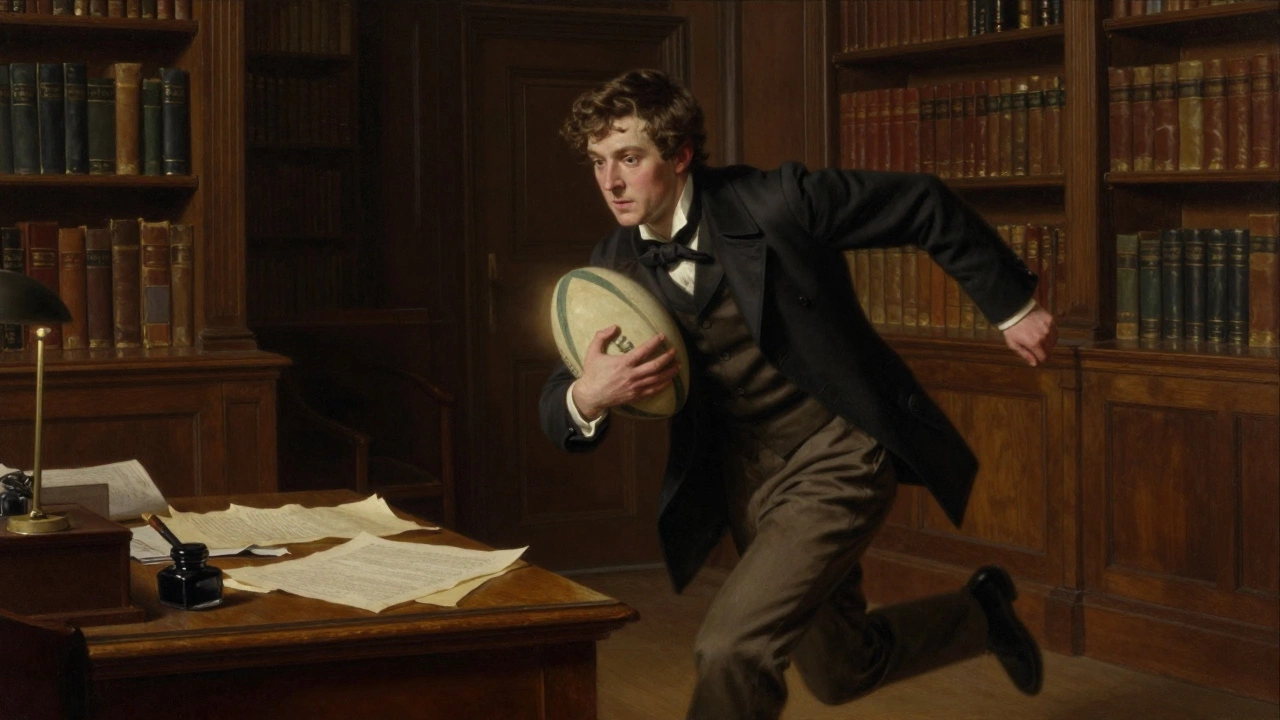
The story goes that in 1823, a 16-year-old student named William Webb Ellis, during a school match, got frustrated with the rules. Instead of kicking the ball as everyone else did, he picked it up and ran with it toward the goal. Whether he actually did it or not, the tale was written down decades later by a former student, Matthew Bloxam, who claimed to have heard it from witnesses. It was published in 1876, long after Ellis had left school and moved on to become a clergyman.
There’s no diary entry, no newspaper report, no photo. Just a memory passed down. But by then, the game had already spread. The name stuck. The story was too good to ignore. So even if Ellis never touched the ball that day, his name became part of the legend-and the sport became known as ‘Rugby Football’ to distinguish it from other versions of football being played in England.
From Schoolyard to Rules
After that moment-or that myth-students at Rugby School started writing down the rules. By 1845, they had the first official set: how to score, how to tackle, what counted as a foul. This was the first time any football code had been formally documented. Other schools began copying the rules. Universities like Cambridge and Oxford started playing it too, though they tweaked the rules to suit their own style.
By the 1860s, the game had split. Some clubs wanted to keep handling the ball. Others wanted to stick to kicking. In 1871, the clubs that favored running with the ball formed the Rugby Football Union (RFU). That’s when the name became official. It wasn’t just a school game anymore. It was a sport with a governing body, a name, and a clear identity.
Why Not Call It Something Else?
At the time, ‘football’ was a blanket term. There was Association Football (soccer), Gridiron Football (American football’s ancestor), and Rugby Football. People didn’t need a fancy name. They just needed to know which version they were playing. So if you were at a match in London and someone said, ‘Let’s go watch the rugby,’ everyone knew you meant the game where you could carry the ball.
The term ‘rugby’ wasn’t even used much at first. It was always ‘Rugby Football.’ But as the sport grew outside England-especially in Wales, New Zealand, and Australia-the word got shortened. By the 1890s, ‘rugby’ was the common term. It was easier to say. And it tied the game directly to its roots.
What About Other Football Codes?
It’s easy to forget that rugby didn’t just become a sport-it birthed others. American football and Canadian football both evolved from rugby rules. The forward pass, the line of scrimmage, even the way teams line up before a play-all came from rugby’s early adaptations. Australian Rules Football, while different, also borrowed elements like high marking and physical tackling.
Meanwhile, soccer (Association Football) went in the opposite direction. It banned handling the ball entirely. That’s why today, when you hear ‘football’ in Europe, you know it means soccer. But in Australia, New Zealand, or parts of England, ‘football’ might mean rugby. Context matters.
Modern Rugby and Its Name
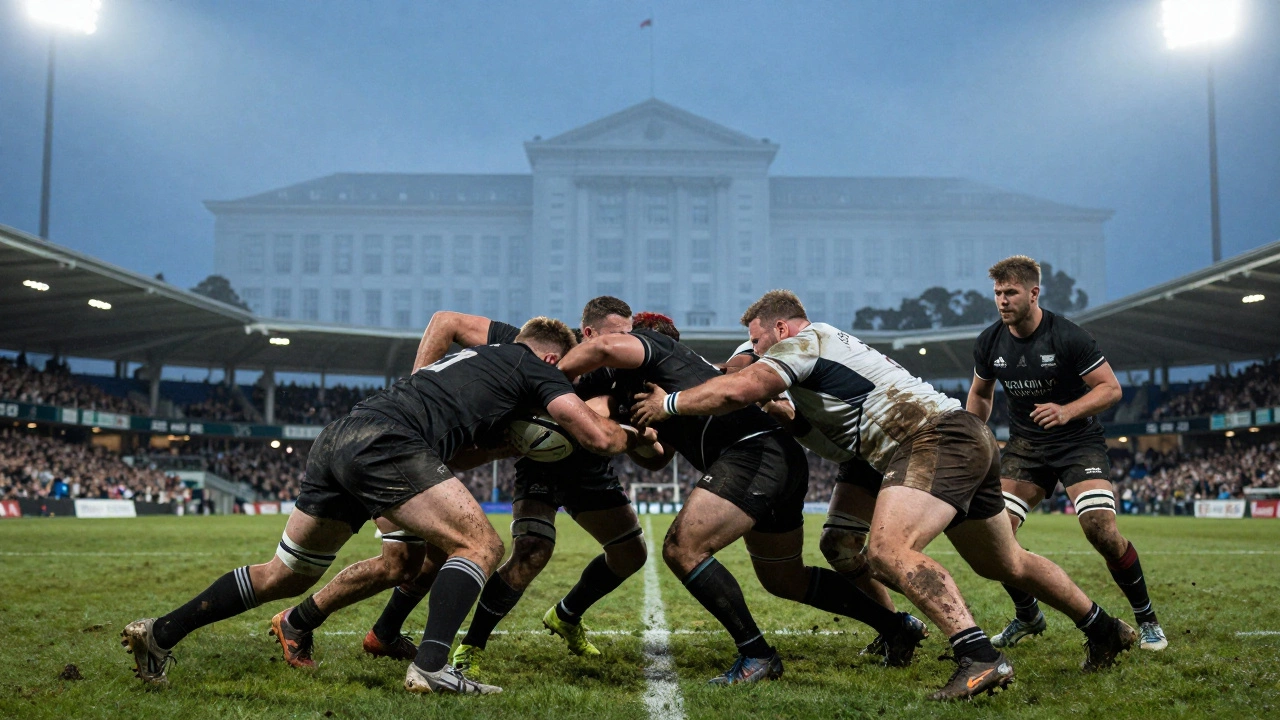
Today, rugby splits into two main codes: Rugby Union and Rugby League. Rugby Union kept the original rules from the RFU. Rugby League broke away in 1895 in Northern England over payment disputes-players wanted to get paid for missing work to play. The split created two different games with different rules, but both still carry the name ‘rugby’ because they both came from that same school in Warwickshire.
Even the World Cup, which started in 1987, is officially called the Rugby World Cup. Not the Football World Cup. Not the Tackle Ball World Cup. Just ‘Rugby.’
Why Does This Matter Today?
Knowing why rugby is called rugby isn’t just trivia. It explains why the game feels different from others. It’s not just about scoring tries or scrums. It’s about a culture that values physicality, teamwork, and tradition. The name reminds players that this sport was shaped by kids breaking rules on a school field-not by committees in boardrooms.
When you watch a match in Sydney or Auckland, you’re not just watching a game. You’re watching a tradition that started with one boy running with a ball, and a school that decided to write it down. The name ‘rugby’ is a link to that moment. And even if the story of William Webb Ellis is more legend than fact, it’s the story that gave the sport its soul.
Final Thought
There’s no secret code, no hidden meaning. Rugby is called rugby because it was born in a town called Rugby. And sometimes, the simplest answers are the ones that last the longest.
Did William Webb Ellis really invent rugby?
There’s no solid proof he did. The story was written down 50 years after the event by someone who wasn’t there. But whether he actually ran with the ball or not, the tale became part of rugby’s identity. The game’s rules were formalized at Rugby School around that time, and the name stuck. The myth matters as much as the truth.
Is rugby the same as football?
It depends on where you are. In England, Australia, and New Zealand, ‘football’ can mean rugby, especially in casual conversation. But globally, ‘football’ usually means soccer. Rugby is one of several football codes-others include American football, Canadian football, and Australian Rules Football. All share roots in 19th-century school games, but only rugby kept the name.
Why is rugby union called that?
In 1871, clubs that wanted to keep the original rules formed the Rugby Football Union. Later, in 1895, a group broke away because they wanted to pay players. That new group became the Northern Rugby Football Union, which eventually turned into Rugby League. The original version became known as Rugby Union to distinguish it. The word ‘union’ refers to the governing body, not the way the game is played.
Was rugby always played with 15 players?
No. Early versions varied. Some school teams played with 20 or more players. The standard of 15 players per side was formalized by the Rugby Football Union in 1877. Rugby League later reduced it to 13 players in 1906 to speed up the game. Today, 15-a-side is still the standard for international rugby union.
Where is the original rugby ball kept?
The original ball from 1823 doesn’t exist. Early rugby balls were made from inflated pig bladders wrapped in leather. They were rounder than today’s oval balls. The modern oval shape came later, as makers realized it was easier to carry and pass. The Rugby Football Union has a few early balls in its collection, but none from the exact 1823 match.