Football vs. Soccer Terminology Explorer
What's It Called in Your Country?
Ever wondered why the same sport is called "football" in most countries but "soccer" in the U.S. and Australia? This tool shows you what the sport is called in different nations.
Why the Different Names?
The game is called "football" because players use their feet (not hands) to play. In English-speaking countries, the term originated from the game's original name: "association football." In places where "football" already meant another sport (like American football in the U.S.), they adopted "soccer" as a shortened term for "association football."
Key difference: Most countries use "football." Only the U.S., Canada, and Australia use "soccer" as the primary term for the sport.
Ever watched a World Cup final and wondered why everyone calls it football in most of the world but soccer in the U.S. and Australia? Or why a game with 22 players and one ball draws over a billion viewers? The answer starts with FIFA.
What FIFA Actually Is
FIFA is the Fédération Internationale de Football Association, the global governing body for football (soccer). It was founded in 1904 in Paris by seven European countries to organize international matches and set uniform rules. Today, it has 211 member associations - more than the United Nations. That means almost every country on Earth plays by FIFA’s rules.
FIFA doesn’t run local leagues or club teams. It doesn’t even own the stadiums. But it controls the biggest stage: the World Cup. Every four years, it picks the host nation, sets the schedule, and decides who gets to play. It also manages international competitions for women, youth, and futsal. Without FIFA, there’d be no unified global structure for the sport.
Football vs. Soccer: Why Two Names?
The game itself is called football in nearly every country because players use their feet - not hands - to move the ball. In places like the United States, Canada, and Australia, though, "football" already meant American football or rugby. So people started calling the sport "soccer" - short for "association football," the formal name used when the game was codified in England in 1863.
Today, "soccer" is mostly used in North America and Australia. Everywhere else, it’s just "football." Don’t be surprised if an Australian friend says "football" and means AFL or rugby - context matters. But when they talk about the World Cup, they mean the same game you see on TV: 90 minutes, two teams, one ball, no hands (except the keeper).
How FIFA Runs the Game
FIFA doesn’t just organize tournaments. It writes the official rulebook - the Laws of the Game. These are updated every year, usually in March. For example, in 2022, FIFA made it official that handball offenses now include any accidental touch that leads to a goal or scoring chance. Before that, referees had more discretion.
FIFA also sets standards for equipment: the ball must be spherical, made of leather or synthetic material, and weigh between 410 and 450 grams. The field must be rectangular, 100-110 meters long and 64-75 meters wide. Even the referee’s whistle has to meet ISO standards.
And yes, FIFA handles VAR - Video Assistant Referee. Introduced in the 2018 World Cup, it’s now used in most top leagues. VAR checks goals, penalties, red cards, and cases of mistaken identity. It’s not perfect - fans still argue about it - but it’s part of the game now.

The World Cup: Why It’s Bigger Than Any Other Sport
The FIFA World Cup is the most-watched single sporting event on Earth. The 2022 final in Qatar drew over 1.5 billion viewers. That’s more than the Super Bowl, the Olympics closing ceremony, or the Cricket World Cup combined.
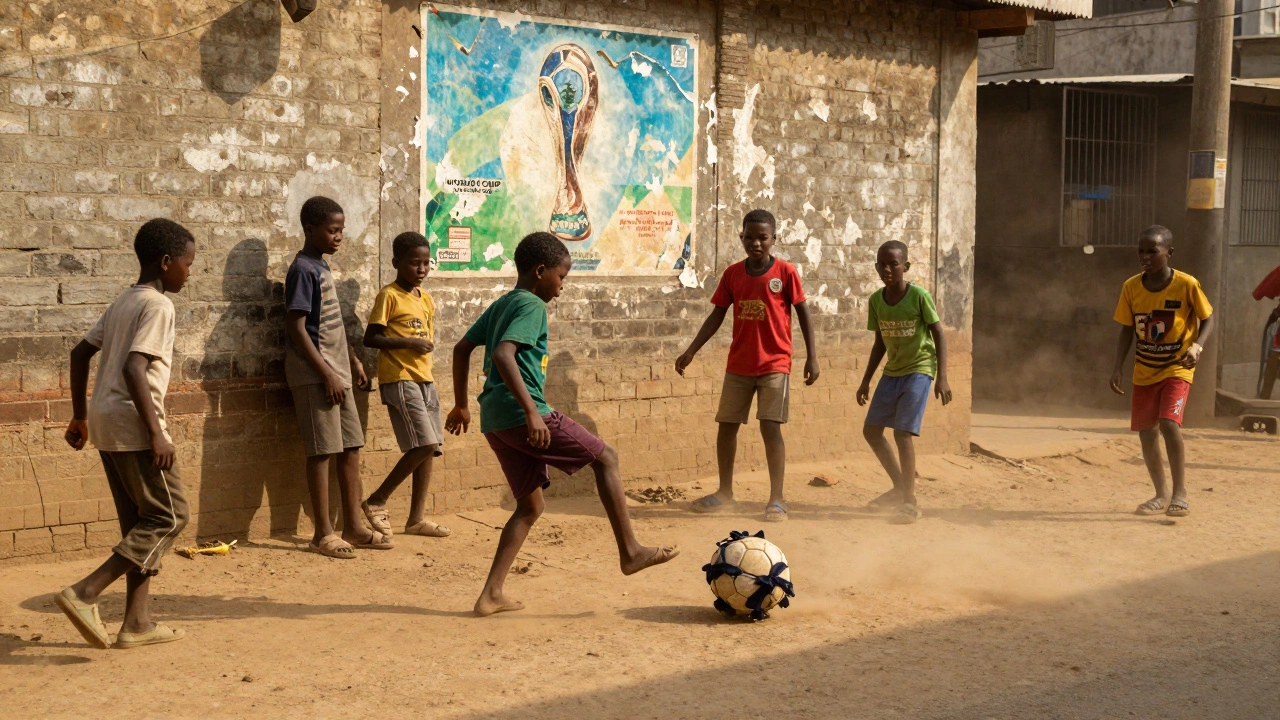
Why? Because football is simple. You don’t need expensive gear. You don’t need a field. A ball and some open space are enough. In slums in Rio, villages in Nigeria, and suburbs in Sydney, kids play with whatever they can find - a rolled-up sock, a plastic bag, a tin can. That’s why it’s the world’s game.
FIFA gives countries a chance to shine. Small nations like Iceland (population 370,000) made it to the 2018 World Cup. Trinidad and Tobago, Jamaica, and even Haiti have qualified. It’s the only global tournament where a country with no professional league can beat one with billionaires owning clubs.
Women’s Football and FIFA’s Role
FIFA launched the Women’s World Cup in 1991. Back then, only 12 teams played, and prize money was a fraction of the men’s. In 2023, 32 teams competed in Australia and New Zealand. The final between Spain and England had over 700 million viewers. Prize money jumped to $110 million - still less than the men’s $440 million, but it’s growing.
FIFA now runs youth tournaments for girls under 17 and under 20. It funds development programs in Africa, Asia, and Latin America. Countries like Nigeria and Brazil have women’s leagues that rival men’s in popularity locally. FIFA’s goal is to get 60% of its member associations to have a women’s national team by 2030. They’re halfway there.
How FIFA Makes Money
FIFA isn’t a charity. It’s a multi-billion-dollar organization. Its main income comes from broadcasting rights, sponsorships, and ticket sales for the World Cup. In 2022, FIFA made $7.5 billion from the Qatar tournament alone. Over 90% of that came from just three sponsors: Adidas, Coca-Cola, and Qatar Airways.
Most of that money goes back into football. FIFA gives $3.5 billion to national associations for grassroots programs, coaching courses, and stadium upgrades. It funds training centers in places like Papua New Guinea and Bhutan. It also pays out $200 million in prize money to teams that qualify for the World Cup.
But FIFA’s been criticized for corruption. In 2015, U.S. authorities arrested several top officials for bribery. Since then, it’s cleaned up its leadership and now publishes financial reports publicly. Transparency is still a work in progress, but it’s better than it was.

What Happens If a Country Breaks FIFA Rules?
FIFA can suspend a country’s football association. That means no international matches, no World Cup qualifiers, no youth tournaments. In 2021, Nigeria was suspended for government interference in its football federation. The ban lasted six months. In 2023, Kuwait was suspended for the same reason - political meddling in sports.
Even clubs can get punished. If a club signs a player under age 15 from another country, FIFA can fine them and ban them from signing new players for two transfer windows. Manchester City got hit with a two-year ban in 2019 for financial fair play violations - later reduced on appeal.
These punishments aren’t just about fairness. They’re about protecting the game’s integrity. Without them, rich clubs or corrupt governments could dominate everything.
How to Get Involved
You don’t need to be a pro to care about FIFA football. If you’re in Australia, join a local community league. Volunteer to coach a junior team. Watch the Women’s World Cup next time it’s on. Buy a jersey from a small nation - not just Brazil or France.
FIFA’s official website has free coaching resources, rulebook downloads, and youth training plans. You can even take an online referee course. It takes three hours. You don’t need experience. Just interest.
Football isn’t about who wins. It’s about who shows up. Whether you’re playing on a dusty field in Perth or watching from a pub in Bondi, you’re part of the same global community. That’s what FIFA made possible.
Is FIFA the same as the World Cup?
No. FIFA is the organization that runs the World Cup, along with other international competitions. The World Cup is the tournament - the event where national teams compete every four years. FIFA is the boss behind the scenes, making the rules, picking the host, and organizing everything.
Why do some countries call it football and others soccer?
It’s about language history. "Football" is the original term used in England since the 1800s. "Soccer" comes from "association football," a term created in the late 1800s to distinguish it from rugby football. In places where "football" already meant another sport - like American football or Australian rules football - people kept using "soccer" to avoid confusion. Most of the world still says "football."
Can any country join FIFA?
Yes, but only if it’s recognized as an independent country by the United Nations. FIFA requires a national football association with a proper structure, a stadium, and at least five organized leagues. Territories like Puerto Rico or Gibraltar can join because they have their own associations, even if they’re not fully independent nations.
Does FIFA control how clubs play?
No. FIFA only governs international matches and national teams. Club competitions like the Champions League are run by UEFA in Europe, CONMEBOL in South America, and other continental bodies. FIFA sets the rules for international play, but clubs follow their own league’s rules - unless they’re playing in a FIFA tournament like the Club World Cup.
How often does FIFA change the rules?
Every year, usually in March. The International Football Association Board (IFAB), which includes FIFA and the four British associations, reviews and votes on rule changes. Recent changes include allowing five substitutions per team, concussion substitutions, and clearer handball rules. These updates are meant to improve fairness and player safety.
What Comes Next
The next World Cup is in 2026 - hosted by the United States, Canada, and Mexico. It’s the first time three countries will host together. The tournament will expand to 48 teams, up from 32. That means more chances for smaller nations to compete on the biggest stage.
FIFA is also pushing for gender equality. By 2030, it wants equal prize money for men’s and women’s World Cups. It’s already funding 150 new women’s football academies across Africa and Asia. The game is changing - and it’s not just about who scores the most goals.
At its core, FIFA football is about connection. It’s the kid in Jakarta who dreams of playing for Indonesia. The grandmother in Lagos who watches every match with her grandchildren. The Australian schoolteacher who organizes a Friday afternoon game in the park. That’s the real power of the game - and why FIFA, for all its flaws, still matters.